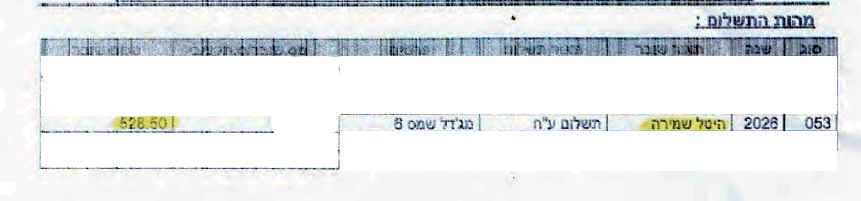

Al-Marsad – Arab Human Rights Center in Golan Heights approached the Majdal Shams Local Council on 15/01/2026 with a set of clarifications—according to the Freedom of Information Law of 1998—after some citizens requested legal advice from Al-Marsad following the local authority’s commencement of collecting guarding fees (tax) from residents (copy of the letter attached). The Local Council did not succeed in providing satisfactory answers to many of Al-Marsad’s questions; its answers were sometimes vague and at other times contrary to the truth, particularly regarding the issue of collecting guarding fees. The Local Council claimed, in its response, that it had not yet begun collecting guarding fees from citizens, while an official invoice issued by the Local Council reached Al-Marsad, proving categorically that the guarding fee has actually been collected from a number of citizens (copy of the paid invoice attached).
Contrary to what was stated in the response of the Majdal Shams Local Council, its temporary cessation of collecting guarding fees did not occur except after Al-Marsad’s approach, which reinforces suspicions that the collection of guarding fees was carried out independently of fulfilling the conditions stipulated in the law. It is clear from the answers received by Al-Marsad that the Local Council’s estimates for the total amounts it will collect annually from the residents of Majdal Shams, through guarding fees alone, will reach approximately 1,100,000 (one hundred and ten million) Shekels. Reading this data in light of the socio-economic classification of the town of Majdal Shams—according to data from the Central Bureau of Statistics (CBS)—allows for the assumption that the decision to impose these fees was made without sufficient and fair study of its economic and social repercussions, particularly on vulnerable groups, and explains the legitimate fear among many residents that this new tax will constitute an additional financial burden, which will weigh heavily on a wide segment of them.
The official statement and announcement by the Local Council that it has not yet begun collecting guarding fees imposes a legal responsibility on it to return the amounts collected to their owners. Accordingly, everyone who paid these fees has the right to approach the Council immediately to recover their dues which were collected without a sound legal reference. Although the Local Council claims to be working on activating a bylaw (Hok Ezer) legally regarding the guarding fee, the constitutionality of this bylaw is still subject to serious legal doubts, in addition to fundamental questions about the nature of the vital facilities or installations that require providing special guarding services justifying the imposition of a financial fee on all residents in exchange, as well as the feasibility of imposing these fees.
In this context, Al-Marsad points out that it sent similar correspondence to local councils in the rest of the Golan villages and received a response from the Mas’ade Local Council explaining that it has not taken such a decision and does not collect guarding fees from the village residents. Although general evidence does not indicate that the rest of the local councils have taken similar steps, we are still waiting for documented official answers before announcing that.
Freedom of Information letter-15/01/2026
Paid invoice
Response letter – 01/02/2026